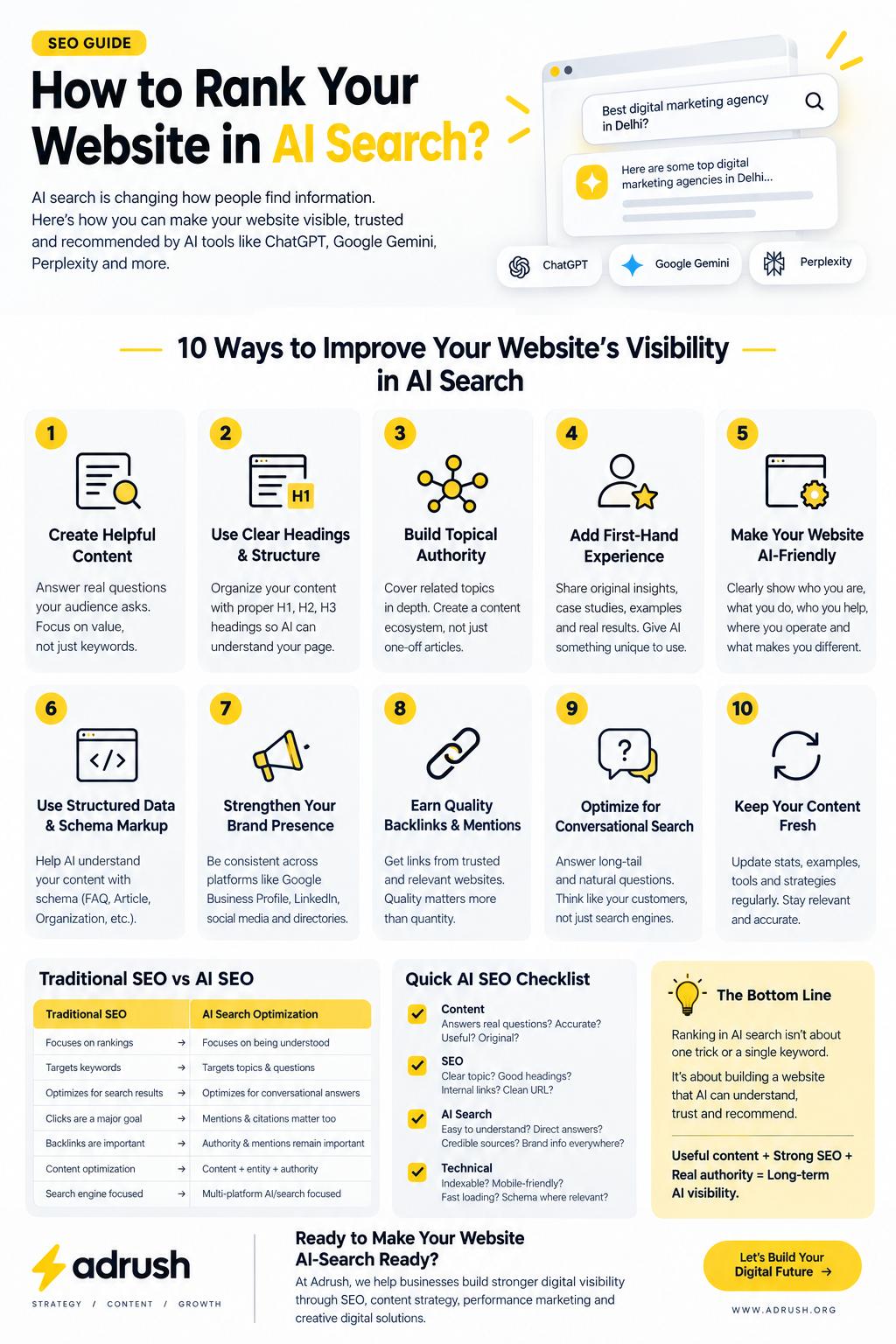
How to Rank Your Website in AI Search: A Complete Guide for 2026
Meta Title: How to Rank Your Website in AI Search in 2026
Meta Description: Learn how to rank your website in AI search results like ChatGPT, Google AI Overviews, Perplexity, and Gemini with practical AI SEO strategies.
Suggested URL: /how-to-rank-website-in-ai-search/
Primary Keyword: how to rank website in AI search
Secondary Keywords: AI SEO, AI search optimization, rank in ChatGPT, Google AI Overviews SEO, generative engine optimization, GEO, AI search ranking
How to Rank Your Website in AI Search?
Search is changing.
A few years ago, if someone wanted to find a digital marketing agency, they would type something like “best digital marketing agency in Delhi” into Google, look at the first few results, and visit different websites.
Today, people are increasingly asking AI tools the same question:
“Which digital marketing agency should I hire for my small business?”
Instead of giving users a traditional list of ten blue links, AI search platforms can provide a direct answer and recommend specific businesses or websites.
This includes platforms such as ChatGPT, Google AI Overviews, Google Gemini, Microsoft Copilot, and Perplexity.
That creates a new question for website owners:
How do you get your website mentioned, cited, or recommended by AI search engines?
The answer is not simply “add more keywords.”
You need to create content that AI systems can understand, trust, verify, and confidently use when generating answers.
This guide explains how AI search works and what you can do to improve your chances of appearing in AI-generated answers.
What Is AI Search?
AI search refers to search experiences where artificial intelligence understands a user’s question and generates a direct answer instead of simply displaying traditional search results.
For example, instead of searching:
“Best marketing agencies in Delhi”
a user might ask:
“What is the best digital marketing agency for a startup in Delhi with a small budget?”
An AI search engine can understand the context behind the question and generate a personalized response.
It may use information from multiple websites to create that answer.
This means SEO is evolving from:
Ranking → Getting clicks
to:
Being discovered → Being understood → Being trusted → Being mentioned
Why AI Search Matters for SEO
Traditional SEO is still important.
However, the way people discover information is changing.
Google has introduced AI-powered search experiences, while platforms such as ChatGPT and Perplexity have made conversational search much more popular.
For businesses, this creates a new opportunity.
Imagine someone asks:
“Who are the best digital marketing agencies for a new business in India?”
If an AI system understands your company, services, expertise, reputation, and website content, your business could potentially become part of that answer.
That’s why businesses are starting to focus on AI SEO, also known as Generative Engine Optimization (GEO).
What Is AI SEO or Generative Engine Optimization (GEO)?
AI SEO is the process of optimizing your website and online presence so that AI-powered search systems can better understand and potentially reference your content.
GEO (Generative Engine Optimization) focuses specifically on improving a brand’s visibility within AI-generated answers.
Traditional SEO asks:
“How can I rank #1 on Google?”
AI SEO asks:
“How can I become a trusted source that AI systems use when answering questions?”
These strategies overlap heavily.
A technically strong website, useful content, good authority, structured information, and strong online reputation can help with both.
10 Ways to Improve Your Website’s Visibility in AI Search
1. Create Content That Actually Answers Questions
One of the biggest mistakes businesses make is writing content purely for keywords.
For example, instead of writing a 1,500-word article that repeatedly uses:
“best digital marketing agency”
create content that genuinely answers questions your customers ask.
Examples include:
- What does a digital marketing agency do?
- How much does digital marketing cost?
- Is SEO better than Google Ads?
- How long does SEO take to produce results?
- How can a small business generate leads online?
- What is the difference between SEO and AI SEO?
- How can businesses use AI for marketing?
Think about the questions your potential customers ask before they buy.
Then answer those questions clearly.
The goal is simple:
Write for the person first and search engines second.
2. Use Clear Headings and Content Structure
AI systems need to understand what your page is about.
A clear structure makes this easier.
Instead of creating one huge block of text, divide your article into logical sections.
For example:
H1:
How to Rank Your Website in AI Search
H2:
What Is AI Search?
H2:
Why AI Search Matters
H2:
How to Optimize Your Website for AI Search
H3:
Create Helpful Content
H3:
Build Topical Authority
H3:
Use Structured Data
This structure also makes your content easier for humans to scan.
3. Build Topical Authority
Publishing one article about SEO isn’t enough to establish strong expertise.
Imagine you want your website to become known for digital marketing.
Instead of publishing one article called:
“What Is Digital Marketing?”
create a complete content ecosystem.
For example:
SEO
- What is SEO?
- On-page SEO guide
- Technical SEO guide
- Local SEO guide
- Keyword research guide
- Internal linking guide
- SEO audit checklist
Google Ads
- What are Google Ads?
- Google Ads bidding strategies
- How much do Google Ads cost?
- Google Ads vs SEO
- Google Ads for small businesses
Social Media Marketing
- Instagram marketing
- Facebook advertising
- Meta Ads targeting
- Social media strategy
- Social media content ideas
This creates topical depth.
When many pages on your website cover related subjects comprehensively, search engines and AI systems have more information to understand your expertise.
4. Write With First-Hand Experience
This is one of the most important strategies for modern SEO.
Don’t simply repeat information that already exists online.
Add your own experience.
For example, instead of saying:
“Facebook Ads can help businesses generate leads.”
you could explain:
“We tested lead-generation campaigns for a local service business and found that reducing the number of form fields increased the number of completed forms.”
That second statement provides something more valuable:
experience.
Whenever possible, include:
- Original research
- Case studies
- Statistics
- Experiments
- Screenshots
- Examples
- Client results
- Your own observations
- Expert opinions
AI systems have access to enormous amounts of generic information.
Your competitive advantage is original information.
5. Make Your Website Easy for AI to Understand
Your website shouldn’t be confusing.
Make sure important information is clearly stated.
For example, your homepage should make it obvious:
Who are you?
What do you do?
Who do you help?
Where do you operate?
What makes you different?
For a digital marketing agency, instead of saying:
“We create digital experiences for ambitious brands.”
you could say:
“Adrush is a digital marketing agency providing SEO, performance marketing, social media marketing, and creative services for businesses in India.”
The second version gives both users and machines much clearer information.
6. Use Structured Data and Schema Markup
Schema markup helps search engines understand the meaning and context of information on your website.
Depending on your website, useful schema types may include:
- Organization
- LocalBusiness
- Article
- FAQPage
- BreadcrumbList
- Service
- Person
- Product
- Review
For example, if you publish an FAQ page, properly implemented FAQ structured data can help search engines understand that your page contains questions and answers.
Important: Schema is not a magic shortcut to AI rankings.
Adding schema does not guarantee that ChatGPT, Google, or another AI system will mention your website.
Think of schema as a way of providing clear machine-readable context.
7. Strengthen Your Brand’s Online Presence
Your website isn’t the only place where your business exists.
AI systems can potentially encounter information about your brand across the wider web.
That’s why your business information should be consistent across platforms.
For example:
Brand name: Adrush
Website: adrush.org
Services: SEO, Digital Marketing, Performance Marketing, Creative Services
Location: Clearly stated where relevant
Build legitimate profiles and mentions across relevant platforms.
These may include:
- Google Business Profile
- Business directories
- Industry websites
- Social media profiles
- Relevant publications
- Partner websites
Don’t create hundreds of low-quality directory profiles just to generate links.
Quality and consistency matter more than quantity.
8. Earn High-Quality Backlinks and Mentions
Backlinks remain an important part of SEO because they can help demonstrate authority and relevance.
But don’t think:
1,000 backlinks = better AI visibility.
A handful of relevant, trustworthy mentions can be more valuable than hundreds of spammy links.
For example, imagine a marketing agency is mentioned by:
- A respected business publication
- An established marketing website
- A local business organization
- A university
- A relevant industry publication
These types of mentions can strengthen the overall credibility of the brand.
Focus on earning links naturally through:
- Original research
- Expert contributions
- Digital PR
- Guest expertise
- Case studies
- Useful resources
- Industry partnerships
9. Optimize for Conversational Search
People don’t always search AI tools using short keywords.
They ask complete questions.
Traditional search:
“SEO agency Delhi”
Conversational search:
“Which SEO agency in Delhi is suitable for a small business with a limited budget?”
Your content should therefore answer long-tail and conversational questions.
Consider creating sections such as:
Is SEO worth it for a small business?
How much should a small business spend on SEO?
How long does SEO take?
Should a startup invest in SEO or Google Ads?
This helps your website cover different search intents.
10. Keep Your Content Fresh
Information changes.
SEO strategies change.
Google changes.
AI search changes.
Marketing platforms change.
An article written three years ago may contain outdated information today.
Regularly review important pages and update:
- Statistics
- Examples
- Screenshots
- Tools
- Pricing information
- Industry developments
- Links
- Strategies
Don’t update content just to change the publication date.
Update it when you have something genuinely useful to add.
Traditional SEO vs AI SEO
| Traditional SEO | AI Search Optimization |
|---|---|
| Focuses heavily on rankings | Focuses on being understood and referenced |
| Targets keywords | Targets topics and questions |
| Optimizes for search results | Optimizes for conversational answers |
| Clicks are a major goal | Mentions and citations can also matter |
| Backlinks are important | Authority and mentions remain important |
| Content optimization | Content + entity + authority optimization |
| Search engine focused | Multi-platform AI/search focused |
The two approaches aren’t competitors.
Strong traditional SEO is still the foundation of AI search visibility.
Does Ranking on Google Guarantee Ranking in ChatGPT?
No.
Ranking highly on Google does not automatically mean that ChatGPT or another AI platform will recommend your website.
Different AI search systems can use different sources, retrieval systems, ranking mechanisms, indexes, and signals.
However, good SEO practices can still provide a strong foundation.
If your website has:
- Helpful content
- Strong topical coverage
- Clear information
- Technical accessibility
- Good reputation
- Relevant backlinks
- Original expertise
- Accurate business information
you are giving both traditional search engines and AI systems better information to work with.
Can You Pay Google or ChatGPT to Rank Your Website in AI Search?
Generally, you should not think of AI search visibility as something you can simply buy through an SEO package.
There is no legitimate shortcut where someone can guarantee:
“Pay us ₹50,000 and ChatGPT will recommend your business.”
Be careful with such claims.
AI search visibility depends on many factors, and the systems themselves can change.
Instead, invest in the fundamentals:
Useful content + technical SEO + authority + brand visibility + real expertise.
How Long Does AI SEO Take?
There isn’t a fixed timeline.
A new website may take months to build meaningful authority in traditional search.
An established website with strong content and brand recognition may already have signals that help it become discoverable.
Your progress depends on factors such as:
- Website age
- Competition
- Content quality
- Domain authority
- Backlink profile
- Brand recognition
- Technical SEO
- Publishing consistency
- Industry
Don’t expect AI SEO to produce results overnight.
Think of it as building digital authority, not chasing a temporary ranking trick.
AI SEO Checklist
Before publishing an article, ask yourself:
Content
☐ Does this article answer a real question?
☐ Is the information accurate?
☐ Does it provide something genuinely useful?
☐ Did I include original examples or experience?
SEO
☐ Is there a clear primary topic?
☐ Is the title descriptive?
☐ Are H2 and H3 headings properly structured?
☐ Are internal links included?
☐ Is the URL clean?
AI Search
☐ Can an AI easily understand what this page is about?
☐ Are important questions answered directly?
☐ Is the information supported by credible sources?
☐ Does the brand have clear information across the web?
Technical
☐ Is the page indexable?
☐ Is the website mobile-friendly?
☐ Does the page load quickly?
☐ Is structured data implemented where appropriate?
The Future of SEO Is Not “AI vs Google”
There is a lot of hype around AI SEO.
You may see people selling secret formulas claiming they know exactly how to make ChatGPT recommend a website.
The reality is more complicated.
AI search is evolving quickly.
What works today may not work exactly the same way tomorrow.
Instead of trying to manipulate AI systems, build something they have a reason to trust.
Create the best answer.
Support it with real expertise.
Make your information easy to understand.
Build a recognizable brand.
Earn real mentions and links.
And maintain a technically healthy website.
That’s a much more sustainable AI SEO strategy.
Final Thoughts
Ranking in AI search isn’t about finding one secret keyword or adding a few lines of schema markup.
It’s about making your website a useful, trustworthy and understandable source of information.
Traditional SEO isn’t dead.
It’s evolving.
The websites that will perform well in the future are likely to be those that combine:
SEO + helpful content + topical authority + technical optimization + brand authority + original expertise.
So if you’re asking “How do I rank my website in AI search?”, don’t start by asking how to trick an AI.
Start by asking:
“Why would an AI trust my website enough to use it as a source?”
Build your website around that question, and you’ll be preparing your business for the next generation of search.
Frequently Asked Questions
1. What is AI SEO?
AI SEO is the practice of optimizing a website and its online presence so AI-powered search systems can better understand, discover, and potentially reference its content.
2. How do I rank my website in ChatGPT?
There is no guaranteed method to rank in ChatGPT. Focus on useful, authoritative content, strong SEO fundamentals, clear brand information, original expertise, and legitimate online mentions.
3. What is GEO in SEO?
GEO stands for Generative Engine Optimization. It refers to optimizing content and online presence for visibility in AI-generated search experiences.
4. Does schema markup help with AI search?
Structured data can help search engines understand your content and entities. However, schema alone does not guarantee visibility in AI-generated answers.
5. Is traditional SEO still important for AI search?
Yes. Technical SEO, crawlability, useful content, topical authority, backlinks, and brand reputation remain important foundations for online visibility.
6. Can a new website appear in AI search?
Yes, a new website can potentially be discovered, but building authority and consistent visibility usually takes time. Focus on publishing genuinely useful content and establishing your brand across relevant online channels.